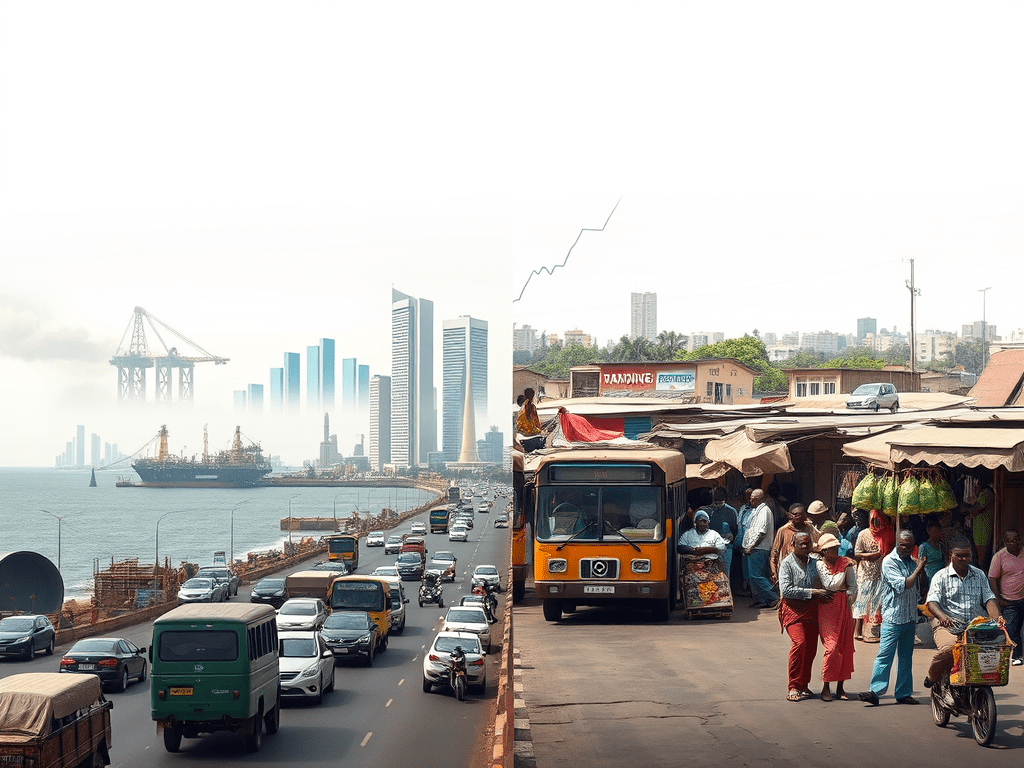
When the Numbers Start Looking Better, But Life Doesn’t
A few years ago, Angola was close to the edge. Oil prices had crashed, debt was ballooning, the currency was sinking, and inflation was eating into everyday life. Then came the IMF program. Soon after, headlines changed, budget deficits narrowed, debt ratios improved. The kwanza stabilized—at least on paper. To global investors and institutions, Angola began to look like a reform success story.
But inside the country, a quieter question started to grow louder: If the reforms worked, why does daily life still feel so hard? This is where Angola’s IMF story becomes interesting. Not because reforms didn’t happen—but because their real impact is far more complicated than the charts suggest.
This article looks at three core pillars of Angola’s IMF-backed reforms—fiscal discipline, tax reforms, and privatization under PROPRIV—and asks a simple but uncomfortable question: Did these changes actually improve the economy, or just improve the statistics?
Fiscal Discipline: Cleaning the Budget
One of the IMF’s first demands was fiscal discipline. Angola had to spend less, borrow less, and stop relying on oil windfalls to plug budget holes. On paper, the government delivered. Budget deficits narrowed sharply, and public debt as a share of GDP began to fall. For an oil-dependent country long addicted to easy money, this was no small shift.
A big reason this worked was the reduction in fuel subsidies. For years, Angola sold fuel far below market prices, draining public finances. Removing these subsidies saved billions and sent a strong signal to the IMF and bond markets. But the savings came with a cost. Transport prices rose, food became more expensive, and inflation hit lower-income households the hardest.
A good example is Luanda’s public transport sector. As fuel prices increased, informal taxis passed the cost to commuters almost overnight. For someone earning a fixed or unstable income, fiscal discipline felt less like reform and more like punishment. The budget improved, but household balance sheets did not.
In short, Angola achieved discipline by cutting expenditure, not by expanding productivity. That made the numbers cleaner—but left the economy weaker beneath the surface.
Tax Reforms: Broadening the Base, Burdening the Few
Another key IMF reform was tax restructuring. Angola needed to rely less on oil revenue and more on stable domestic taxation. The government introduced VAT, improved tax administration, and pushed businesses into the formal system. From a policy perspective, this was overdue.
VAT, in particular, became a symbol of reform success. Tax collection improved, and non-oil revenue rose steadily. International observers applauded Angola for finally building a modern tax system instead of living off oil rents.
But the problem was timing and structure. Angola introduced VAT in an economy where most people were already struggling with inflation and weak job growth. Small businesses, many of them informal by necessity, suddenly faced compliance costs they were not ready for. Meanwhile, large corporations with better legal and accounting support adjusted far more easily.
A clear example can be seen in the retail sector. Large supermarket chains passed VAT smoothly through pricing systems, while small shop owners struggled to register, file returns, and manage cash flows. The result was not just higher prices, but increased pressure on the very businesses that employ most Angolans.
So while tax reforms improved revenue stability, they did little to stimulate growth or reduce inequality. The state collected more, but the economy didn’t feel more alive.
PROPRIV and Privatization: Reform or Repackaging?
Privatization was meant to be Angola’s boldest reform. Under the PROPRIV program, hundreds of state-owned enterprises were listed for sale. The idea was simple: reduce state dominance, improve efficiency, attract investment, and end decades of mismanagement.
In practice, results were mixed. Some smaller assets were successfully sold, and a few sectors became more competitive. The IMF praised the program as a sign that Angola was serious about market reforms.
But many high-value assets either attracted limited interest or ended up in the hands of politically connected buyers. Transparency improved compared to the past, but trust remained fragile. Investors were cautious, worried about regulatory risk and weak institutions.
A telling example is the sale of state-owned industrial and agricultural assets. While ownership changed, productivity often did not. New owners faced the same old problems—poor infrastructure, unreliable power supply, and limited access to finance. Privatization changed who owned the problem, not the problem itself.
Instead of becoming growth engines, many privatized firms simply survived. PROPRIV looked like reform from afar, but up close it often felt like repackaging.
Macroeconomic Stability vs Real Economic Life
To be fair, IMF reforms did bring stability. Inflation came down from extreme highs. The exchange rate became more predictable. Angola avoided a full-blown debt crisis when many peers struggled.
But stability is not the same as growth. Youth unemployment remains high. Poverty levels are stubborn. Oil production is declining, and non-oil sectors have not expanded fast enough to compensate.
The IMF helped Angola stop the bleeding. It did not cure the disease.
A Better Balance Sheet, But an Unfinished Story
Angola’s IMF-backed reforms worked—if your definition of success is cleaner budgets, improved ratios, and calmer bond markets. Fiscal discipline reduced deficits. Tax reforms stabilized revenue. Privatization trimmed the state’s role. From a macro perspective, Angola looks far more credible today than it did a decade ago.
But if success is measured by jobs, incomes, and everyday economic confidence, the picture is far less convincing. The reforms fixed the state faster than they fixed the economy. Stability arrived before opportunity.
So the real question is not whether the IMF program worked—but whether Angola can now move beyond it. Can fiscal discipline turn into productive investment? Can tax reforms support growth instead of just collection? Can privatization create real businesses, not just new owners?
Because if Angola stops at better numbers, the reform story ends here. But if it uses this stability as a foundation, the real chapter may still be waiting to be written.



 Financial Realtalks
Leave a comment