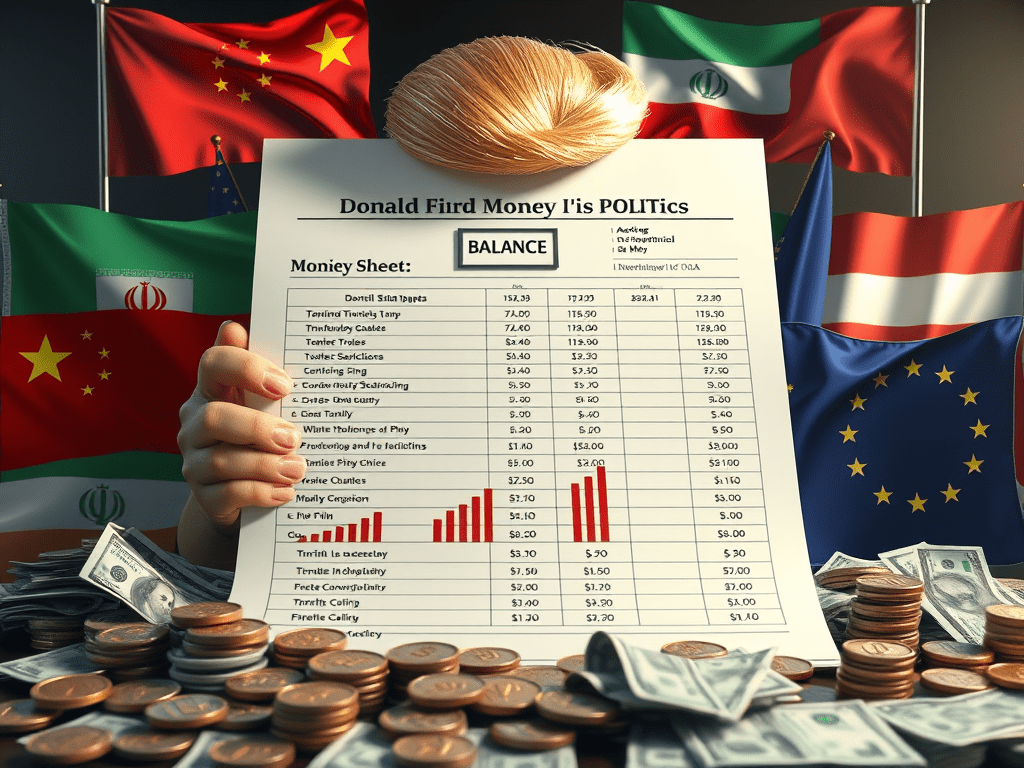
Money-First View
Politics is often described as the art of compromise, diplomacy, and long-term vision. But under Donald Trump, politics seemed to become something else entirely — a balance sheet. For him, nearly every dispute, whether with rivals abroad or allies at home, had a dollar sign attached to it. The Trump playbook was simple: turn foreign policy, trade, and even diplomatic crises into financial negotiations. While some saw this as refreshing candor, others argue it reduced America’s complex global role to the equivalent of a business deal.
This article dives into how Trump’s “money-first” worldview shaped decisions on sanctions, tariffs, and even disputes with allies — and what that tells us about the way he sees power.
Sanctions as Financial Weapons
Sanctions have always been a tool in America’s arsenal, but under Trump they often looked less like punishment for wrongdoing and more like leverage for bargaining. When countries detained American citizens, Trump’s response frequently circled back to economic pain points — “we’ll make them pay.” Instead of nuanced diplomacy, sanctions became dollar-driven threats, forcing other nations to measure the cost of angering Washington in financial rather than political terms.
Take Iran, for example. Trump pulled the U.S. out of the nuclear deal and reimposed sweeping sanctions. He didn’t just argue on security grounds; he highlighted how billions were being drained from Iran’s economy as proof of American success. For him, numbers on lost revenue were the scoreboard.
Tariffs: The Businessman’s Foreign Policy
Perhaps nowhere was Trump’s transactional mindset clearer than tariffs. Trade wasn’t about fostering cooperation or strengthening alliances — it was about who was winning on the ledger. Whether it was China, Mexico, or the European Union, Trump imposed tariffs as if he were negotiating a contract, not leading a country.
The China tariffs are the best example. Trump proudly announced the billions collected from tariffs, framing them as payments from Beijing to the U.S. Treasury — even though, in reality, American consumers and businesses bore much of the cost. Still, for Trump, the optics mattered: America was no longer being “ripped off,” because the numbers finally looked like profits.
Punishing Allies with Dollars
It wasn’t just adversaries who felt Trump’s financial stick. Even allies like the European Union were not spared. When the EU slapped Google with more than $2 billion in antitrust fines, Trump’s response was classic: threaten counter-sanctions. Instead of seeing the move as Europe trying to regulate big tech, he framed it as Europe stealing American money. For Trump, this wasn’t about competition or legal frameworks — it was about financial loss and how to make Europe pay for it.
In his worldview, allies didn’t get free passes. NATO countries were constantly reminded of their “unpaid bills,” as Trump pressed them to meet defense spending commitments. To him, alliances weren’t about shared values but overdue invoices.
Dollars Over Diplomacy
Even in sensitive situations like detentions of U.S. citizens abroad, the financial framing dominated. Trump often positioned such crises not in terms of human rights or moral duty, but as failures of those governments that would be punished economically until they “paid the price.” It was as if lives were part of the broader transaction ledger.
This approach resonated with some Americans who liked the blunt, no-nonsense style — finally, someone was treating America’s power like a business empire. But for critics, it stripped away the human and strategic dimensions of governance, leaving only the bottom line.
The Bigger Picture
What made Trump different wasn’t just that he used money as a tool — plenty of presidents have. It was that he treated everything as a transaction. Whether it was foreign aid, trade disputes, sanctions, or alliances, the calculation was always: is America making or losing money? If the U.S. was “losing,” Trump would flip the table, just as he might in a tough real estate deal.
This mindset simplified complex global issues into win-lose scorecards. But it also ignored the longer-term consequences: broken alliances, strained diplomacy, and the rise of global competitors filling the gaps left behind.
Conclusion
Donald Trump’s presidency can be summed up in one phrase: “show me the money.” From sanctions to tariffs, from punishing adversaries to pressing allies, everything was a negotiation with a dollar figure attached. For some, that made him a pragmatic leader who put America’s interests first. For others, it reduced the richness of global diplomacy into little more than a business contract.
But here’s the real question: Can a world as interconnected and fragile as ours truly be run like a business deal — or does that approach risk turning every friend into a customer and every rival into a debtor?




 Financial Realtalks
Leave a comment